There’s a reason the American Shorthair consistently ranks among the top five most popular cat breeds in the United States — and it has nothing to do with trends. This is a cat that earns its place in your home through sheer good character. Not flashy, not fragile, not demanding. Just genuinely, reliably wonderful.
If you’ve ever lived with one, you probably nodded at that last sentence. If you’re still on the fence, keep reading — because what makes the American Shorthair special isn’t something you can fully capture in a bullet point list. It lives in the small moments: the way they settle beside you on the couch without being clingy, the steady purr at 11 PM, the calm curiosity when your toddler toddles past.
This guide covers everything — history, personality, health, colors, pricing, and the stuff the polished breed pamphlets tend to gloss over.
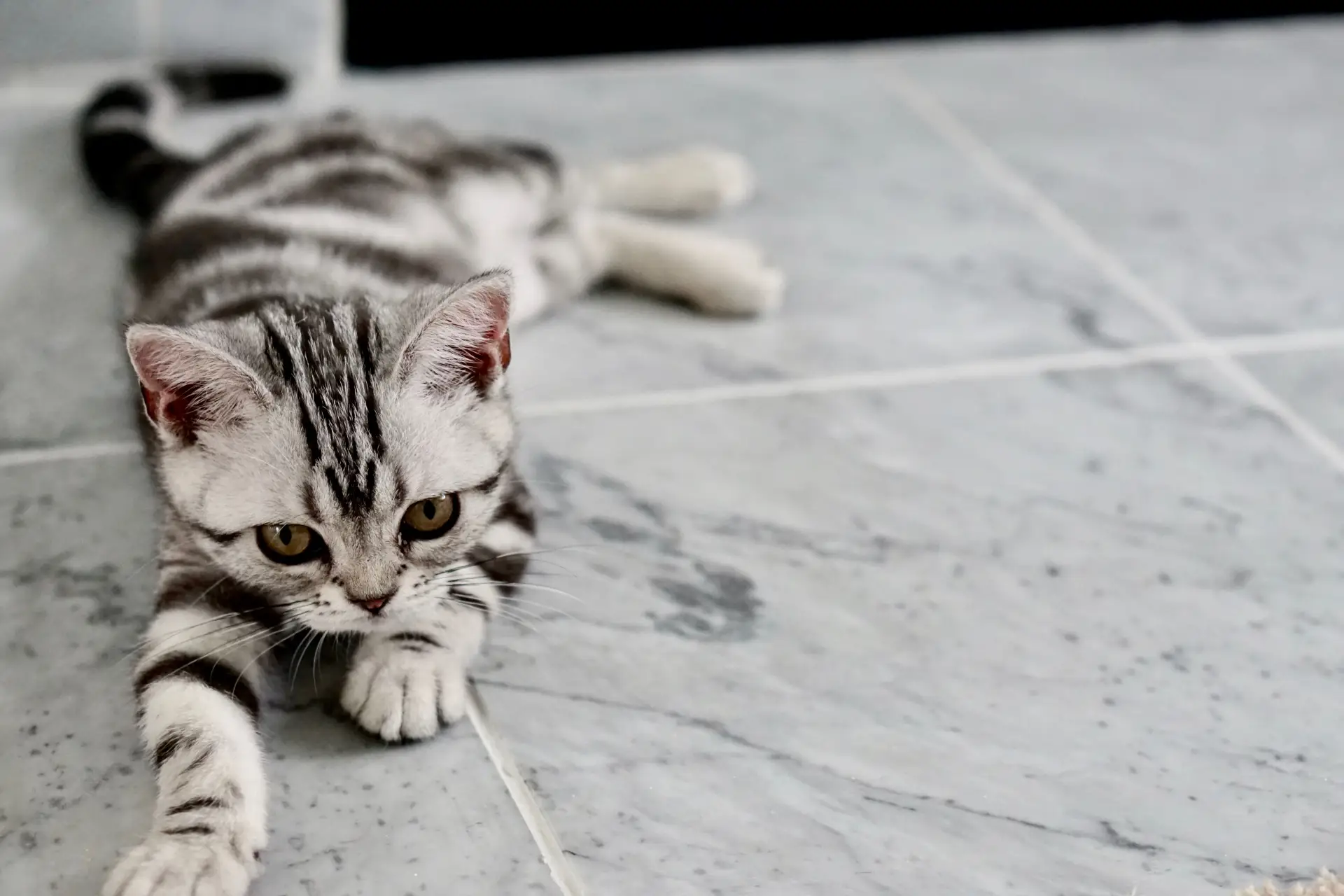 The iconic silver tabby is arguably the most recognizable American Shorthair look — bold, clean, and undeniably striking.
Key Takeaways
- Born from working stock, bred for resilience. The American Shorthair’s robust health and easygoing temperament aren’t coincidental — they’re centuries in the making.
- Adaptable without being a pushover. This breed fits into families, single-person households, apartments, and farmhouses with equal grace.
- The coat is low-maintenance, but not zero-maintenance. Seasonal shedding is real and worth preparing for.
- They age beautifully. With proper care, American Shorthairs routinely live 15–20 years, becoming true lifelong companions.
- More than 80 recognized color variations exist within the breed — meaning no two American Shorthairs look exactly alike.
- Pricing is reasonable for a pedigree cat, but “reasonable” in the cat world still means doing your homework on breeders.
Quick Overview
| Trait | Detail |
|---|---|
| Origin | United States (descended from European working cats brought by early settlers) |
| Size | Medium to large |
| Weight | Males 11–15 lbs; females 8–12 lbs |
| Lifespan | 15–20 years |
| Coat | Short, dense, and hard-textured with a protective quality |
| Color | Over 80 recognized patterns and colors, including silver tabby, brown tabby, black, white, and bicolor |
| Temperament | Calm, adaptable, affectionate but independent, gentle with children and other pets |
| Grooming | Weekly brushing recommended; increase during spring/fall shedding seasons |
| Price | $600–$1,500 from reputable breeders; $50–$200 for adoption from shelters |
From Ship Cats to Show Cats: The American Shorthair’s Surprisingly Rich History
Here’s something that tends to surprise people: the American Shorthair is one of the oldest recognized pedigree breeds in North America, yet for most of its existence, nobody was calling it a “breed” at all.
These cats came over on the Mayflower. Seriously. Historical records suggest domestic shorthaired cats sailed with the Pilgrims in 1620, brought aboard specifically to hunt rodents and protect food stores on the crossing. They weren’t pampered pets — they were working animals, valued for their toughness and hunting ability.
Once ashore, these cats spread across the colonies and kept right on working. Farms, grain stores, ships docked in harbor — wherever vermin were a problem, these sturdy, adaptable cats showed up. Centuries of natural selection in a demanding environment did something remarkable: it shaped a cat that was healthy, even-tempered, and physically robust. You don’t survive harsh winters and colonial-era hardship by being delicate.
Fast forward to the early 1900s. Cat fancy was becoming fashionable in America, and breeders started noticing that the common American working cat — the barn cat, the ship cat, the alley cat — had real qualities worth preserving and refining. In 1906, the Cat Fanciers’ Association (CFA) recognized the breed under the name “Domestic Shorthair.” The name wasn’t changed to “American Shorthair” until 1966, partly to distinguish the pedigree breed from random-bred domestic cats and to honor its distinctly American identity.
The silver tabby male named “Bell of Bradford” is often cited as one of the first American Shorthairs to be formally registered, imported from England in the early 1900s to strengthen the breeding program. But the heart of this breed has always been its American roots — the scrappy, self-sufficient ancestors that crossed an ocean and built a life here.
What an American Shorthair Actually Looks Like (Beyond the Breed Standard)
On paper, the American Shorthair is described as “medium to large, with a well-balanced, symmetrical body.” That’s accurate but undersells it. In person, these cats look substantial — not fat, just genuinely solid. Pick one up and you’ll feel it immediately. There’s real weight and muscle there, which is part of what makes them feel so different from more delicate breeds.
The face is one of their most distinctive features: wide, open, and friendly-looking. Full cheeks, a medium-length nose, large round eyes (often gold or green, though it varies by coat color), and medium-sized ears set wide apart. It’s an approachable face — the cat equivalent of someone who immediately seems like a good person.
Their legs are medium length and well-muscled, built for agility rather than speed. Paws are rounded and firm. The tail is medium length, thick at the base, and tapers to a blunt tip.
The coat itself deserves a closer look. It’s short, but it’s not silky or fine — it has a noticeably dense, hard texture that was developed to protect against moisture and cold. Run your hand through it and you’ll feel the thickness. This coat was practical once; now it just feels satisfying to pet.
Males run noticeably larger than females. A fully grown male American Shorthair can hit 15 pounds without being overweight — they’re just big cats. Females stay more compact, typically 8–12 pounds. Both sexes take 3–4 years to fully mature physically, so don’t be surprised if your “adult” cat at age two still fills out a bit more.
The Color Spectrum: Why American Shorthair Genetics Are Endlessly Fascinating
If you’re the type who geeks out on genetics even a little, the American Shorthair’s color variation is genuinely impressive. The CFA officially recognizes over 80 different colors and patterns within the breed. That’s not a typo.
The most iconic is the silver tabby — the white-silver base with bold, dark gray-black markings that look almost painted on. This is the version you’ve probably seen in advertisements, on calendars, and in your mind’s eye when someone says “classic tabby.” The contrast is striking and the genetics behind it involve the inhibitor gene suppressing the base coat color to produce that silver ground color.
Beyond the silver tabby, the American Shorthair comes in:
- Brown tabby — warm, rich, honey-brown with dark brown markings
- Red/orange tabby — vivid orange with deep red markings
- Blue tabby — a soft blue-gray ground with deeper blue markings (gorgeous and underrated)
- Solid colors — black, white, blue, red, and cream solids
- Bicolor — any of the above combined with white patches
- Smoke — the base coat is white, the tips are colored; in motion, it creates a smoky, shimmering effect
- Calico and tortoiseshell — the familiar three-color and two-tone patterns
- Shaded and shell patterns — where the color tipping is more subtle, creating an almost ethereal look
The tabby pattern itself appears in four variations: classic (blotched), mackerel (striped), spotted, and ticked — with the classic swirling pattern being most common in the breed.
One thing worth knowing: coat color in the American Shorthair doesn’t affect temperament. You’re not getting a calmer cat by picking a solid blue or a feistier one by choosing a red tabby. That’s a folk myth. Personality is shaped by genetics and early socialization, not coat pigmentation.
The Real Personality of an American Shorthair Cat (Not the Press Release Version)
Every breed description for the American Shorthair uses words like “easy-going,” “adaptable,” and “good with children.” All true. But let me fill in some texture, because the reality is more interesting than those adjectives suggest.
The American Shorthair is not a lap cat by default. They enjoy your company deeply — don’t misunderstand — but they tend to express affection on their own terms. They’ll sit near you, follow you from room to room, and position themselves where they can keep an eye on things. They’re present without being velcro-attached. If you pick them up when they weren’t planning on it, some will tolerate it politely, and some will politely but firmly let you know they’d prefer to come to you.
They are remarkably unflappable. New furniture, a visiting dog, a crying baby, a vacuum cleaner — many American Shorthairs take all of this in stride with a kind of philosophical calm. This isn’t dullness; it’s genuine stability. It’s why they’re considered excellent family cats and good matches for multi-pet households.
Here’s the part that surprises some new owners: they have a real play drive that lasts well into adulthood. Their working-cat heritage left them with keen hunting instincts, and an under-stimulated American Shorthair will find ways to entertain itself — which may or may not involve your houseplants or the curtains. Daily interactive play isn’t optional; it’s part of the deal.
They also tend to be curious and observant in a way that feels almost methodical. Watch yours when something new enters the room. They don’t rush over immediately. They watch first, assess, and then investigate at their own pace. There’s a deliberateness to them that’s oddly refreshing.
They’re generally quiet — not silent, but not vocal in the way a Siamese would make you second-guess your life choices at 3 AM. They’ll communicate, but they’re not dramatic about it.
One genuine heads-up: because American Shorthairs are so adaptable and self-sufficient, it’s easy to underestimate how much enrichment they need. They won’t stage a protest. They won’t yowl at you. They’ll just quietly become a bit bored and a bit sedentary. Regular play sessions, puzzle feeders, window access, and interaction matter more than their calm exterior suggests.
Keeping an American Shorthair Happy: Real-World Daily Care
Feeding
American Shorthairs have a healthy appetite and a slight predisposition to weight gain, especially after they’re spayed or neutered and particularly as they move into middle age. This doesn’t mean you need to be obsessive about it, but it does mean free-feeding (leaving food out all day) isn’t ideal for most of them. Measured meals twice a day — a high-quality protein-rich food with animal protein as the first ingredient — works well. Keep an eye on body condition: you should be able to feel the ribs easily but not see them.
Grooming
This is where the American Shorthair genuinely earns its “low maintenance” reputation — with a caveat. Weekly brushing is enough during most of the year to manage shedding and keep the coat in good shape. But during spring and fall, when they blow their coat seasonally? You’ll want to bump that up to two or three times a week. Brush with a rubber curry comb or a bristle brush — their dense coat responds well to both.
A monthly nail trim, ear checks, and occasional tooth brushing rounds out the routine. If you start these habits when they’re kittens, most American Shorthairs are quite cooperative about the whole thing.
Exercise & Enrichment
Twenty minutes of active, interactive play daily is the floor, not the ceiling. Wand toys, feather toys, laser pointers (always end with a physical toy they can “catch” for a satisfying conclusion), puzzle feeders — variety keeps their hunting instincts engaged. A tall cat tree near a window where they can watch birds and squirrels is genuinely valuable; many American Shorthairs can spend hours in watchful observation mode.
They’re athletic enough to appreciate vertical space, so if you can provide wall-mounted shelves or multilevel cat furniture, they’ll use it.
Environment
Purely indoor living is fine — and recommended for longevity. An American Shorthair with outdoor access will live a shorter, riskier life statistically. But an indoor American Shorthair with good enrichment, regular play, and window access to the outside world will be completely content.
What to Actually Expect Health-Wise: An Honest Look at the American Shorthair’s Lifespan
Note: This section discusses health considerations. Please consult your veterinarian for personalized advice.
One of the genuine advantages of the American Shorthair’s working-cat heritage is genetic diversity — they don’t carry the concentrated genetic load of heavily inbred breeds. As a result, they’re considered one of the healthier pedigree breeds available.
Lifespan: 15–20 years. This isn’t wishful thinking. American Shorthairs commonly reach their late teens with good care, and it’s not unusual to hear of individuals reaching 20. If you’re adopting one, you’re signing up for a long relationship.
The main health concern: Hypertrophic Cardiomyopathy (HCM). This is a thickening of the heart muscle that’s the most common cardiac disease in cats generally, and the American Shorthair has a known genetic predisposition to it. Reputable breeders screen their breeding cats with annual echocardiograms. Ask about this specifically when you’re talking to breeders — any serious breeder will know exactly what you’re talking about and will have documentation.
Signs to watch for as your cat ages: reduced activity, labored breathing, weight loss, or a reduced appetite. Annual vet check-ups that include listening carefully to the heart are important, and many vets recommend echocardiograms for American Shorthairs starting around age 5-6.
Obesity risk is worth taking seriously. A somewhat sedentary lifestyle plus a healthy appetite plus middle age equals weight creeping up quietly. Obesity in cats contributes to diabetes, joint problems, and reduced lifespan. It’s one of the most preventable health issues and one of the most commonly overlooked.
Dental disease is common across all domestic cats, and American Shorthairs are no exception. Tooth brushing (yes, it’s a thing, and yes, your cat will be suspicious of it at first) and dental-appropriate foods or treats help. Annual dental cleanings under anesthesia may become part of your senior cat’s routine.
Beyond these, the American Shorthair is generally robust. They’re not prone to the respiratory issues of flat-faced breeds or the spinal problems of some other breeds. Their structure is functional and sound.
⚠️ Health Disclaimer: This information is for educational purposes only and is not a substitute for professional veterinary advice. Always consult a licensed veterinarian for diagnosis, treatment, and health decisions regarding your cat.
Finding an American Shorthair in the US: What You’ll Pay and Where to Look
The American Shorthair isn’t rare in the United States — this is, in many ways, America’s own cat — but that doesn’t mean finding a quality pedigree kitten is a quick errand.
From a registered breeder, expect to pay between $600 and $1,500 for a pet-quality kitten. Show-quality kittens from champion bloodlines can push past $2,000. These prices reflect health testing, proper socialization, quality nutrition during kittenhood, and the breeder’s years of investment in the breed. A kitten advertised for $200 from an unregistered “breeder” isn’t a deal — it’s a risk.
When evaluating breeders, look for:
- CFA or TICA registration
- HCM screening documentation for the parents
- Kittens raised in a home environment (not a cage-based cattery)
- A contract that includes a health guarantee
- A breeder who asks you questions too — good breeders are selective about where their kittens go
Adoption is always worth considering. While true pedigree American Shorthairs are less common in shelters, domestic shorthairs with American Shorthair characteristics (sturdy build, tabby markings, calm temperament) show up regularly. Adoption fees typically run $50–$200 and often include spay/neuter, vaccinations, and microchipping. Breed-specific rescues exist, though they’re less common for this breed than for some others.
Waiting lists are common with reputable breeders. A 3–6 month wait for a kitten is normal and actually a good sign — it suggests the breeder isn’t overproducing. Patience here pays off.
Frequently Asked Questions About American Shorthair Cats
Are American Shorthair cats good for first-time cat owners?
Honestly, yes — they’re probably one of the best choices for first-time owners. Their adaptability, general hardiness, and even-keeled temperament make the learning curve much more forgiving than it would be with a higher-maintenance or more sensitive breed. They’re not fragile, they’re not neurotic, and they communicate clearly without being dramatic. That said, “easy” doesn’t mean “zero effort” — daily play and regular vet care still matter.
Do American Shorthair cats shed a lot?
Moderate shedding year-round, with two heavier shedding seasons in spring and fall. If you’re wearing black clothes around an American Shorthair during shedding season, expect silver tabby accessories on your sleeves. Weekly brushing handles most of it outside of peak seasons. A good lint roller becomes your best friend.
How do American Shorthair cats do with dogs?
Generally quite well, especially if the introduction is handled thoughtfully and gradually. Their calm, confident temperament means they’re less likely to panic and flee — which can sometimes trigger a dog’s chase instinct — and more likely to hold their ground and assess the situation. Most American Shorthairs that are properly introduced to a resident dog develop at least a comfortable coexistence, and many form genuine bonds.
Are American Shorthair cats hypoallergenic?
No. No domestic cat breed is truly hypoallergenic — the allergen (Fel d 1 protein) is present in all cats’ saliva, skin, and urine regardless of coat length or type. The American Shorthair produces Fel d 1 at typical levels. If allergies are a concern, spend time with the individual cat before bringing them home, as sensitivity varies.
How long does an American Shorthair cat live?
The typical range is 15–20 years, and this is genuinely achievable with good care — not just an optimistic outlier case. Annual vet visits, appropriate nutrition, indoor living, weight management, and dental care are the main levers. It’s worth factoring this into your decision: adopting an American Shorthair kitten is a 15–20 year commitment.
Are American Shorthair cats indoor or outdoor cats?
Reputable breeders and veterinary professionals almost universally recommend keeping them indoors. Outdoor cats face risks — traffic, predators, infectious diseases, toxic plants — that significantly reduce average lifespan. An American Shorthair with good environmental enrichment indoors will be perfectly content and significantly safer.
What’s the difference between an American Shorthair and a domestic shorthair?
The “Domestic Shorthair” is a generic term for any short-coated mixed-breed cat — essentially a cat of indeterminate ancestry. An American Shorthair is a specific pedigree breed with documented lineage, breed standards, and health testing. Many domestic shorthairs look similar to American Shorthairs (especially tabby-patterned ones), which is why the breed changed its name from “Domestic Shorthair” in 1966 to avoid the confusion.
Do American Shorthair cats like to be held?
This varies by individual, but as a breed, they tend to be affectionate on their own terms rather than constantly seeking to be held. Many enjoy being near their people and will accept being picked up, but they typically prefer to initiate contact rather than be scooped up unexpectedly. Respect their signals and they’ll come to you more often. Force the issue and you’ll get polite but firm resistance.
At what age is an American Shorthair fully grown?
Later than you might expect — American Shorthairs typically take 3–4 years to reach their full adult size. This is longer than many breeds. So if your one-year-old looks a bit lanky or your two-year-old seems to still be filling out, that’s completely normal. Males in particular continue to develop their characteristic broad, muscular build well into their third or fourth year.
How much does an American Shorthair cost in the United States?
From a reputable registered breeder, pet-quality kittens typically range from $600 to $1,500. Show-quality kittens can exceed $2,000. Adoption from a shelter or rescue is significantly less ($50–$200) and is always worth exploring first. Be cautious of unusually low prices from unregistered sources — the hidden costs of health issues often far exceed any upfront savings.
The American Shorthair isn’t a cat that demands your attention or performs for your approval. It’s better than that — it simply shows up, day after day, as a calm, curious, genuinely good companion. Whether you’re a family with young kids, a solo apartment dweller, or somewhere in between, this breed has a way of fitting naturally into your life rather than disrupting it.
That’s not an accident. That’s four hundred years of doing exactly this job, and doing it well.