There’s a moment every Exotic Shorthair owner knows well. You’re sitting on the couch, half-watching something on TV, and suddenly there’s this dense, warm, teddy-bear-shaped cat just… materializing in your lap. No dramatic entrance, no loud announcement. Just a soft thud and a pair of enormous copper eyes staring up at you like you’re the most interesting thing in the room. That’s the Exotic Shorthair experience in a nutshell — quietly devoted, profoundly cozy, and just a little bit hilarious.
If you’ve been researching flat-faced cats and keep circling back to the Exotic Shorthair, you’re not alone. They’ve quietly become one of the most popular cat breeds in the United States, and once you understand what makes them tick, it’s genuinely hard to choose anything else.
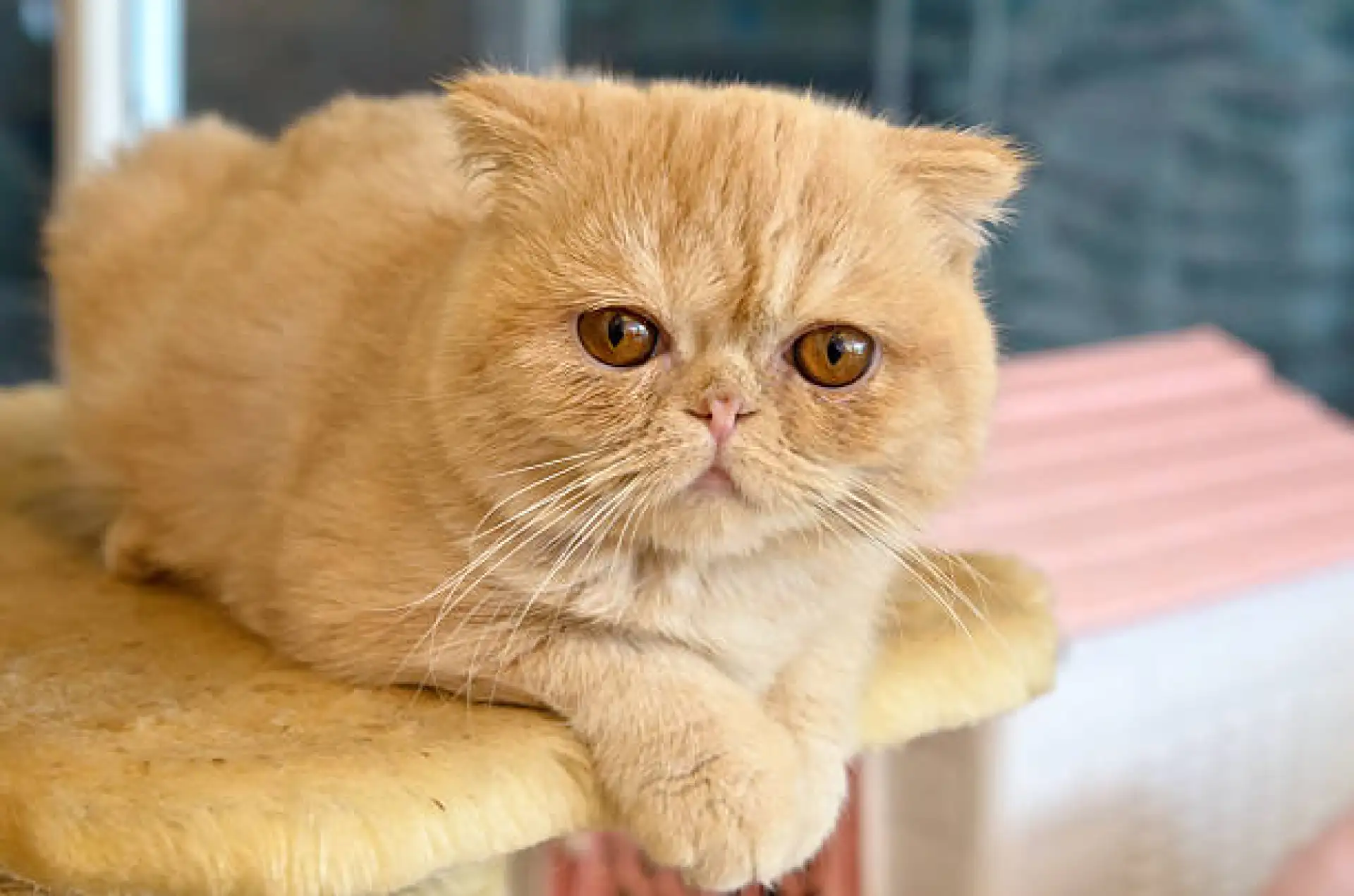
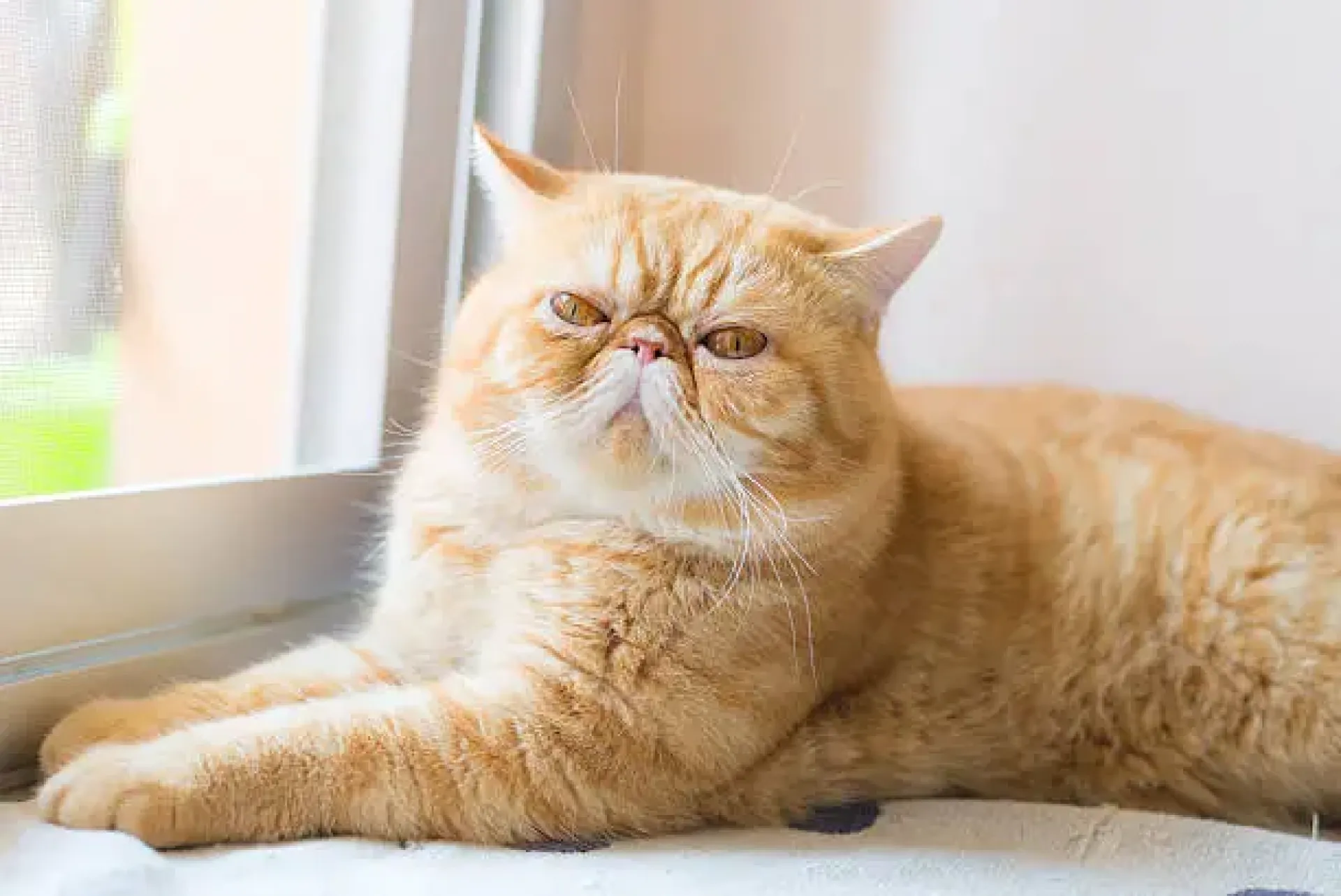 The signature Exotic Shorthair look — round face, flat nose, and those impossibly expressive eyes.
Key Takeaways
- Built like a Persian, but low-maintenance on the grooming front — the short, plush coat is the breed’s biggest practical advantage over its Persian ancestors.
- Calm and adaptable — Exotic Shorthairs thrive in apartments, houses, and virtually any living situation as long as they have their people nearby.
- Quiet but communicative — they’re not silent, but they’re far from demanding. Expect soft chirps and meaningful stares rather than 3 a.m. yowling sessions.
- Brachycephalic health risks are real — the flat face that makes them irresistible also comes with specific health considerations that every owner needs to understand upfront.
- Not budget cats — expect to pay $1,200–$2,500+ from a reputable breeder, and budget for ongoing vet care that’s a little above average.
- Surprisingly playful — don’t let the “couch potato” reputation fool you. Exotics have a genuine playful streak, especially during their younger years.
Quick Overview
| Trait | Detail |
|---|---|
| Origin | United States (developed in the 1950s–60s by crossing American Shorthairs with Persians) |
| Size | Medium to large, stocky and compact build |
| Weight | 7–12 lbs (males tend toward the heavier end) |
| Lifespan | 12–15 years with proper care |
| Coat | Short, dense, plush double coat that stands away from the body |
| Color | Nearly every color and pattern imaginable — solid, tabby, bi-color, colorpoint, and more |
| Temperament | Gentle, calm, affectionate, and quietly loyal with a playful side |
| Grooming | Weekly brushing is sufficient; no daily detangling like a Persian requires |
| Price | $1,200–$2,500+ from a reputable US breeder; rescue/adoption varies |
How the Exotic Shorthair Came to Be (And Why It Was Almost Kept a Secret)
The origin story of the Exotic Shorthair is one of the more entertainingly sneaky chapters in cat breeding history. Back in the late 1950s, American Shorthair breeders were quietly crossing their cats with Persians — not to create a new breed, but to improve the body type and coat texture of their American Shorthairs. The resulting kittens had that heavy Persian build but with shorter coats, and breeders were, frankly, trying to pass them off as purebred American Shorthairs.
A CFA judge named Jane Martinke noticed something was off. She recognized that these hybrid cats weren’t just “improved” American Shorthairs — they were something genuinely new. Rather than burying the crossbreeding program, she championed the idea of officially recognizing them as their own breed. By 1966, the Cat Fanciers’ Association (CFA) granted the Exotic Shorthair full breed recognition.
The breed was initially called the “Sterling” (for silver-coated cats specifically), but the name “Exotic Shorthair” eventually stuck. Through the 1970s and 80s, Burmese and Russian Blue genetics were occasionally introduced, though the Persian remains the dominant ancestral influence. Today’s Exotic Shorthairs are essentially shorthaired Persians in everything but coat length — the breed standards are nearly identical.
What’s interesting is how quickly they went from “awkward secret” to beloved. Once cat fanciers realized they were getting Persian personality and looks without Persian grooming requirements, the breed exploded in popularity. It’s not hard to see why.
That Face, That Body: What Exotic Shorthairs Actually Look Like Up Close
The first thing anyone notices is the face. The Exotic Shorthair is a brachycephalic breed, meaning the skull structure is compressed so that the face appears flat — or “peke-faced” in breeder terminology. The nose sits almost level with the eyes, the cheeks are dramatically round and full, and the overall expression is one of permanent, gentle bewilderment. Some people find it endearing; some find it a little alien. Almost nobody finds it forgettable.
Beyond the face, the body is built like a small tank. Exotic Shorthairs are medium to large cats with a low-slung, cobby frame — broad shoulders, a wide chest, short thick legs, and a round, substantial head that looks almost comically large relative to the ears. Those ears, by the way, are small and set wide apart, which only amplifies the “round balloon with ears” silhouette.
 Exotic Shorthair kittens: the brachycephalic features are pronounced early, with that characteristic wide-eyed, smooshed-face look.
The coat is where Exotics genuinely diverge from Persians in a practical way. It’s short — but “short” here doesn’t mean sleek like a Siamese. The double coat is dense and plush, almost velveteen, and it stands away from the body slightly rather than lying flat. Run your hand through it and it springs back. It’s extraordinarily satisfying to touch, which is probably why so many Exotic owners absentmindedly pet their cats for way longer than they intended.
Eye color varies with coat color but is always large and round — copper, gold, blue (in colorpoints), or green (in some silver/golden varieties). The combination of enormous round eyes and a flat face creates an expression that reads as perpetually curious or mildly concerned, depending on your interpretation.
A Rainbow in Plush: The Coat Colors and Genetic Variety of Exotic Shorthairs
One of the most underappreciated aspects of the Exotic Shorthair is just how enormous the color and pattern range is. The CFA recognizes Exotic Shorthairs in virtually every color and pattern that exists in domestic cats — which, when you start counting, is genuinely staggering.
Solid colors include white, black, blue (a soft gray), red, cream, chocolate, and lilac. Shaded and smoke varieties give the coat a silvery or smoky depth that looks almost metallic in certain lighting. Tabby patterns come in classic (swirled), mackerel (striped), spotted, and ticked variations across multiple base colors. Bi-color and calico cats show white combined with other colors, and colorpoints — like the Himalayan patterning — are also fully recognized, where the face, ears, paws, and tail are darker than the body.
Some of the most sought-after (and expensive) color varieties:
- Chinchilla Silver — white undercoat tipped with black, giving the coat an almost glittering appearance
- Golden — similar tipping pattern but with a warm golden base, creating an almost ethereal look
- Blue Colorpoint — the classic Himalayan pattern in blue-gray, with striking blue eyes
- Tortoiseshell — patchwork of red and black (almost always female due to genetics)
On the genetics side, the flat face is controlled by the same gene responsible for Persian facial structure. The shorthair coat is inherited from the American Shorthair side — the gene for short coat is dominant over long coat, but Exotic Shorthairs can carry the longhair gene and occasionally produce longhaired kittens (these are called “Exotic Longhairs” and have their own separate recognition status).
The wide color range means that even if you’ve seen a lot of Exotic Shorthairs, you can still be surprised by a color combination you haven’t encountered before. That’s part of the fun.
The Real Personality of Exotic Shorthairs (It’s More Nuanced Than “Calm Lap Cat”)
Here’s where a lot of breed guides sell Exotic Shorthairs short: they describe the temperament as “calm” and “easygoing” and leave it at that, as if owning one is like owning a very attractive throw pillow. The reality is richer and frankly more entertaining.
Yes, Exotic Shorthairs are calm. They’re not the cats that will knock your coffee off the counter for sport (usually) or demand to be fed at 5 a.m. by sitting on your face. They have a low-key quality that makes them genuinely restful to live with. But “calm” isn’t the same as “inert.”
Exotics have a playful streak that catches new owners off guard. Dangle a feather wand and watch a supposedly dignified Exotic absolutely lose its composure trying to catch it. They love interactive toys, puzzle feeders, and — this is very specific to the breed — crinkle balls. Something about the sound and texture of those silver crinkle balls sends them into a low-key hunting frenzy that’s deeply at odds with their usually composed demeanor.
They’re also deeply, quietly devoted to their people. Not in a Siamese way where the cat is vocally codependent and follows you from room to room making commentary — Exotic Shorthairs prefer to simply be near you. They’ll position themselves in whatever room you’re in. They’ll sit beside you rather than necessarily on you, though lap-sitting is absolutely in their repertoire on their own terms.
The relationship with children and other pets is generally warm but measured. They’ll tolerate a toddler’s enthusiastic attention better than most breeds, but they have a quiet dignity about them — they’ll remove themselves from situations they find overstimulating rather than acting out. With dogs, they tend to coexist peacefully as long as introductions are done right, and with other cats, they’re usually affable and relatively social.
One personality note that surprises people: Exotic Shorthairs can be genuinely funny. Not in a Bengal “chaos agent” way, but in a deadpan, accidental way. The flat face combined with the big eyes gives them an expressive range that reads as deeply human sometimes. You’ll catch your Exotic staring at something invisible on the wall with the same focused intensity it applies to an actual toy, and the expression is identical. That earnest absurdity is part of what makes them so beloved.
Day-to-Day Life With an Exotic Shorthair: What Care Actually Looks Like
Grooming (The Good News and the Fine Print)
The main practical advantage of the Exotic Shorthair over a Persian is the coat. Weekly brushing with a good-quality slicker brush or a wide-tooth comb is genuinely enough to keep the coat in good condition and manage shedding. Spring and fall bring heavier seasonal shedding — during those periods, bump it to twice a week and you’ll save yourself from living inside a lint roller.
Bathing every 4–6 weeks is recommended, especially because the dense coat can trap oils close to the skin. Exotics don’t love baths — few cats do — but with early socialization and a patient approach, most tolerate it reasonably well. Use a gentle cat shampoo and make sure you rinse thoroughly, because product residue in that dense coat can cause skin irritation.
The face requires daily attention that the coat doesn’t. That flat face means the tear ducts drain poorly, leading to tear staining under the eyes — a reddish-brown discoloration that’s very common in brachycephalic breeds. Wipe the face daily with a soft, damp cloth or unscented pet-safe wipes. It takes about 30 seconds and becomes a habit quickly. Ignore it for a week and you’ll have a much more stubborn staining problem to deal with.
Dental care matters for all cats, but the compressed jaw structure in Exotics makes dental overcrowding more common, which can accelerate tartar buildup. Brushing teeth a few times a week (or at minimum using dental treats and water additives) is a genuine investment in their long-term health.
Diet and Weight Management
Exotic Shorthairs have a robust, stocky build, but that stockiness can tip into genuine obesity if you’re not thoughtful about feeding. They’re not naturally high-activity cats, so their caloric needs are actually fairly modest. Measured meals twice daily rather than free-feeding is the approach most vets recommend.
High-quality protein-forward food — wet food especially — is ideal. The extra moisture from wet food also supports kidney health, which matters for this breed (more on that in the health section). A fully wet diet or a wet/dry combination works well; purely dry kibble diets are manageable but less ideal.
Exercise (Yes, They Need It)
The “couch potato” reputation is partly earned but partly exaggerated. Exotic Shorthairs aren’t going to self-exercise the way a Bengal or Abyssinian might. They need you to initiate play, and they need it daily — two 10–15 minute interactive play sessions each day is a realistic and effective target. Feather wands, laser pointers, and puzzle feeders work particularly well.
Without adequate play, Exotics can become bored and sedentary, which compounds weight gain and can lead to behavioral changes like increased vocalization or mild destructiveness. They’re not naturally demanding about exercise, so it’s on you to build it into the routine.
Health Profile: The Honest Reality of Owning a Flat-Faced Cat
Note: This section discusses health considerations. Please consult your veterinarian for personalized advice.
Exotic Shorthairs are generally healthy cats with a lifespan of 12–15 years, but the brachycephalic face structure comes with a specific set of health considerations that anyone considering this breed needs to understand fully — not to be scared off, but to be genuinely prepared.
Brachycephalic Obstructive Airway Syndrome (BOAS) is the umbrella term for breathing difficulties caused by the compressed facial structure. In practice, this ranges from mild snoring (charming) to significant respiratory distress (not charming). Cats with more extreme facial flattening are at higher risk. Signs to watch for include chronic mouth breathing, exercise intolerance, and loud breathing at rest. Mild cases are managed with lifestyle adjustments; severe cases may require surgical intervention to widen the nostrils or shorten the soft palate.
Polycystic Kidney Disease (PKD) is a genetic condition inherited from the Persian side of the family. It causes fluid-filled cysts to develop in the kidneys over time. Reputable breeders test for PKD using DNA screening and will provide documentation — this is a non-negotiable thing to ask for when buying from a breeder. PKD-positive cats often live normal lifespans if caught early and managed with appropriate diet and vet monitoring.
Dental crowding due to the compressed jaw structure makes periodontal disease more common. Regular dental care and annual professional cleanings are genuinely important here, not just nice-to-have.
Heat sensitivity is a real concern. The compromised airway makes it harder for Exotics to regulate body temperature through panting (which is already an inefficient cooling mechanism in cats). Keep your home reasonably cool during hot months and never leave an Exotic in a hot car or unventilated room.
Entropion — a condition where the eyelid rolls inward, causing the lashes to rub against the eye — occurs more frequently in brachycephalic cats. It causes discomfort and chronic eye irritation and may require surgical correction.
None of these conditions are universal or inevitable, and many Exotic Shorthairs live long, healthy lives with minimal medical drama. But buying from a health-tested breeder and committing to regular veterinary care (twice-yearly check-ups rather than once-yearly is a smart choice for this breed) makes an enormous difference in outcomes.
⚠️ Health Disclaimer: This information is for educational purposes only and is not a substitute for professional veterinary advice. Always consult a licensed veterinarian for diagnosis, treatment, and health decisions regarding your cat.
What It Costs to Own an Exotic Shorthair in the United States (The Full Picture)
Exotic Shorthairs sit comfortably in the “premium” cat price bracket. A pet-quality kitten from a reputable, health-tested breeder typically runs $1,200–$2,500. Show-quality kittens with exceptional type (closer to the breed standard ideal) can reach $3,000–$5,000 or more. Unusual or highly sought-after colors like chinchilla silver or golden command a premium even within pet-quality pricing.
The price range exists for real reasons. Reputable breeders invest in genetic health testing (PKD screening, genetic panels), quality veterinary care for breeding cats and kittens, proper socialization, vaccinations, and often a health guarantee. A $500 Exotic Shorthair kitten from an unverified online listing is a significant gamble — it may be a kitten from a kitten mill or backyard breeder with no health testing and poor early socialization, which tends to result in much higher lifetime veterinary costs.
Finding an Exotic Shorthair through rescue is possible but requires patience. Organizations like Specialty Purebred Cat Rescue and PersianMeows Rescue occasionally have Exotic Shorthairs available. The CFA and TICA breeder referral lists are reliable starting points for finding reputable breeders. Adoption fees through rescue typically run $150–$500.
Ongoing costs to budget for:
- Premium food: $50–$100/month depending on diet
- Regular vet care: $300–$600/year for healthy cats; more during illness or dental procedures
- Grooming supplies: modest one-time investment ($30–$60 for a good brush and nail clippers)
- Pet insurance: strongly recommended for this breed given the health risks; $30–$60/month for a solid plan
The Exotic Shorthair isn’t a low-cost pet over its lifetime, but owners consistently describe the companionship as worth the investment. That’s not marketing — it’s just what happens when you spend a decade or more with a cat this genuinely good-natured.
Frequently Asked Questions About Exotic Shorthairs
Are Exotic Shorthairs good for first-time cat owners?
Honestly, yes — they’re one of the better choices for first-time cat owners specifically because of their adaptable, non-demanding temperament. They’re not cats that require constant stimulation or elaborate environmental enrichment to stay happy. That said, first-time owners need to go in with clear eyes about the health considerations and face-care routine. The daily eye-wiping and more frequent vet visits are non-negotiable parts of the deal.
Do Exotic Shorthairs shed a lot?
More than you might expect from a “shorthaired” cat — yes. That plush double coat does shed, and during seasonal changes (particularly spring), you’ll notice it significantly. Weekly brushing handles it well, and a lint roller becomes your friend. They don’t shed as dramatically as a Maine Coon or a full Persian, but don’t go in expecting a low-shed experience either.
Are Exotic Shorthairs hypoallergenic?
No. No cat is truly hypoallergenic, and Exotic Shorthairs are absolutely not on the lower end of the allergen spectrum. They produce the Fel d 1 protein (the primary cat allergen) at typical cat levels. If allergies are a concern, spend time with an Exotic Shorthair before committing — individual reactions vary considerably.
How do Exotic Shorthairs get along with dogs?
Generally quite well, provided introductions are handled gradually and thoughtfully. Exotic Shorthairs have the calm temperament to not escalate tensions, and they’ll typically find a peaceful coexistence with a dog that’s been properly introduced. They’ll simply remove themselves from situations that feel threatening rather than lashing out — though a very high-energy or prey-driven dog may be too stressful for the average Exotic.
Do Exotic Shorthairs like being held?
It varies by individual, but many Exotics are affectionate in a “near you but maybe not on you” way rather than being cuddle fanatics. They like being in the same room, will accept and sometimes actively seek out lap time, but rarely demand to be held constantly. When they do settle on you, though, they stay — that dense, heavy warmth is very much a feature.
What’s the difference between an Exotic Shorthair and a Persian?
The coat is the primary practical difference — Persians have the long, flowing coat that requires daily brushing to prevent matting; Exotic Shorthairs have the plush short coat that only needs weekly attention. Temperamentally and in terms of body type, they’re nearly identical. Exotic Shorthairs are sometimes described as “the lazy person’s Persian” — affectionately, and because it’s accurate.
Can Exotic Shorthairs be left alone during the day?
Yes, they handle alone time better than many more vocal or active breeds. They’re not prone to separation anxiety in the dramatic sense, though like any social animal, they shouldn’t be left alone for extended periods without some environmental enrichment. If you work long hours, consider getting two cats so they have company — Exotic Shorthairs generally get along well with another cat.
How do I find a reputable Exotic Shorthair breeder in the US?
Start with the CFA’s breeder referral program and TICA’s breeder directory — both organizations have member breeders who agree to a code of ethics. Look for breeders who voluntarily test for PKD and provide documentation, who raise kittens in a home environment, who ask you questions (a good breeder is screening you as much as you’re screening them), and who offer a health guarantee. Any breeder unwilling to show you health testing results or let you see the kitten’s living conditions is a red flag worth taking seriously.
What’s the lifespan of an Exotic Shorthair?
With good care, regular veterinary attention, and a bit of genetic luck, 12–15 years is a realistic expectation. Some individuals live into their late teens. The health conditions associated with brachycephalic breeds can shorten lifespan if unmanaged, which is why preventive care and buying from health-tested breeding programs matters so much.
Are male or female Exotic Shorthairs better?
Neither is objectively “better” — it really comes down to individual personality and your preference. Males tend to be slightly larger and sometimes a touch more laid-back and affectionate; females can be a bit more independent and opinionated. Both make wonderful companions, and in spayed/neutered cats (which all pet Exotics should be), the personality differences are subtle. Meet the specific kitten or cat you’re considering and trust your gut on the connection.
The Exotic Shorthair isn’t a cat for everyone — no breed truly is. But for the right person or family, they slot into daily life with such ease and warmth that it’s almost startling. They ask for relatively little and give back an enormous amount of quiet companionship, occasional comedy, and that indescribable feeling of having a small, fuzzy creature that is genuinely, contentedly happy to be wherever you are. That’s a pretty good deal, all things considered.