There’s a moment every Ragdoll cat owner knows intimately — you sit down on the couch, and within thirty seconds, twenty pounds of silky, blue-eyed fluff materializes in your lap like it was always meant to be there. No dramatic leap, no hesitant circling. Just a cat who has decided that you are the most important thing in the room, and you should probably accept that.
Ragdolls don’t just live with you. They follow you from room to room, wait outside the bathroom door, and somehow always end up exactly where you are. If you wanted a cat that does “independent and aloof,” this is the wrong breed entirely. But if you want something closer to a dog-cat hybrid wrapped in a cloud of fur? You’ve just found your person.
This guide covers everything — the breed’s origin story, that famously floppy temperament, the coat colors that make breeders obsessed, real grooming truths, health risks nobody warns you about enough, and what you’ll actually spend to bring one home in the US today.
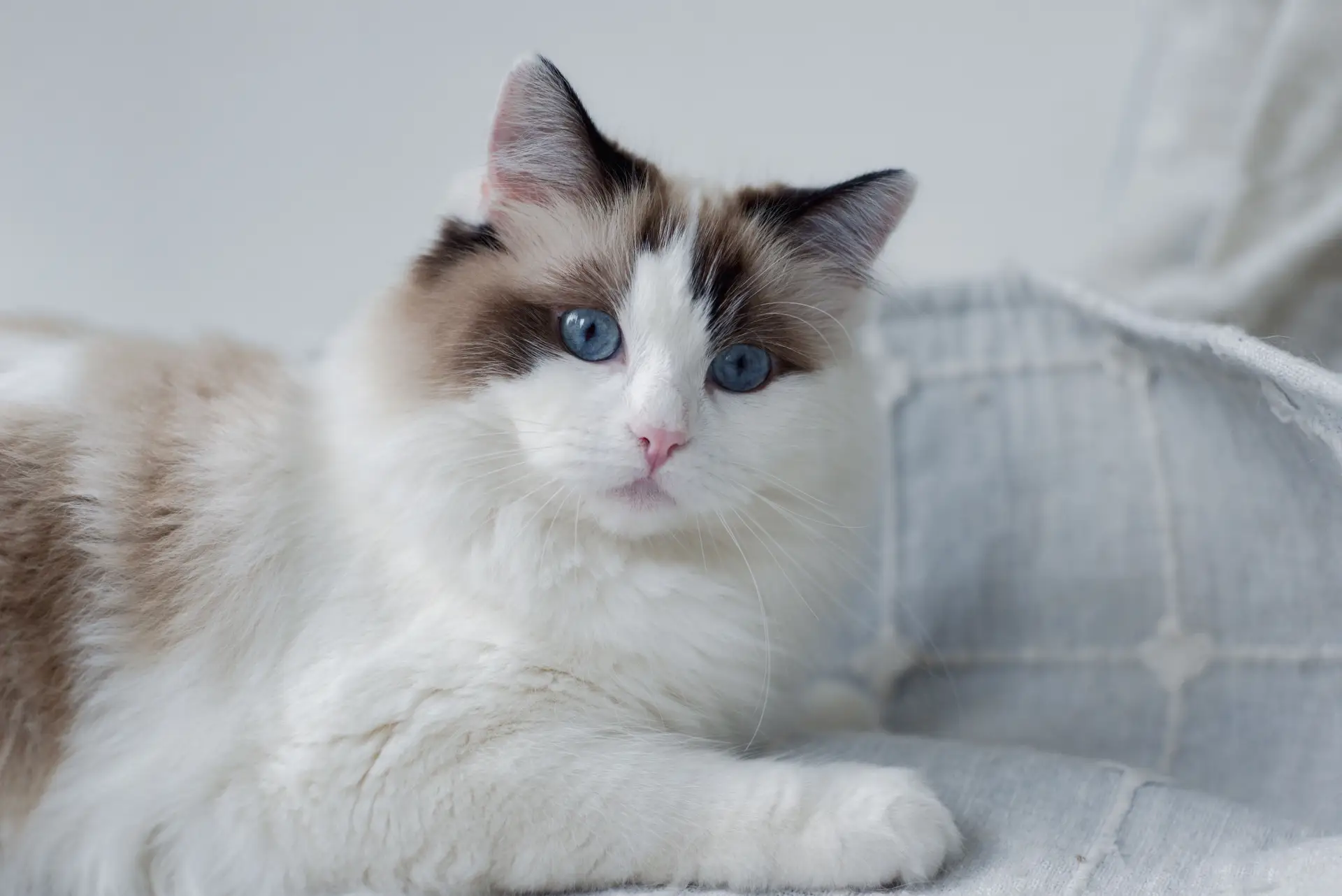 A classic Ragdoll showing off those signature ice-blue eyes and plush, semi-long coat.
Key Takeaways
- Ragdolls go limp when held — this isn’t a myth. Most Ragdolls genuinely relax their muscles when you pick them up, which is where the breed name comes from.
- They are one of the largest domestic cat breeds, with males regularly hitting 15–20 lbs at full maturity (which takes about four years).
- Those blue eyes are non-negotiable — according to the Cat Fanciers’ Association (CFA) breed standard, all true Ragdolls must have blue eyes.
- They’re slower to mature than almost any other breed, meaning you get a kitten phase that stretches nearly four years long — which is either wonderful or exhausting, depending on your perspective.
- Grooming is easier than you’d expect for a cat with this much fur, because their coat lacks a dense undercoat and doesn’t mat easily.
- They’re genuinely not great outdoor cats — their trusting, low-aggression temperament makes them dangerously naive around traffic and other animals.
Quick Overview
| Trait | Detail |
|---|---|
| Origin | Riverside, California, USA, developed in the 1960s by breeder Ann Baker |
| Size | Large to very large; one of the biggest domestic cat breeds |
| Weight | Males: 15–20 lbs; Females: 10–15 lbs |
| Lifespan | 12–17 years on average |
| Coat | Semi-long, silky, low-mat, single-layer coat |
| Color | Seal, blue, chocolate, lilac, red, and cream in various patterns |
| Temperament | Affectionate, calm, people-oriented, gentle, and somewhat dog-like |
| Grooming | Moderate — brush 2–3 times per week; increases seasonally |
| Price | $1,000–$3,500+ from reputable US breeders; adoption possible but rare |
The Origin Story Behind the Ragdoll Cat’s Surprisingly Dramatic History
The Ragdoll’s origin story sounds almost too wild to be true — and honestly, parts of it still are.
In 1960s Riverside, California, a breeder named Ann Baker became fascinated with the kittens born to a white, semi-feral cat named Josephine. These kittens were unusually calm, floppy when held, and seemed to have a lower-than-normal pain threshold. Baker became convinced that Josephine had been genetically altered after surviving a car accident — a theory that has been thoroughly debunked by geneticists, but which she promoted aggressively for decades.
Despite the pseudoscience attached to the breed’s early history, Baker was onto something real. She selectively bred for the traits she observed — large size, docile temperament, blue eyes, pointed coloring — and created a remarkably consistent cat. She founded the International Ragdoll Cat Association (IRCA) in 1971, operating it as a tightly controlled franchise with unusual rules and cult-like restrictions on breeders.
Two breeders, Denny and Laura Dayton, eventually broke away from Baker’s program and worked to get the Ragdoll recognized by mainstream cat registries without Baker’s restrictions. Their efforts paid off: the CFA accepted Ragdolls for registration in 1993 and granted full championship status in 2000.
What we’re left with is a breed built on bizarre mythology but resulting in one of the most genuinely consistent and beloved temperaments in the cat world. The science behind the “limpness” is likely a combination of careful temperament selection and possibly a genetic predisposition to muscle relaxation when lifted — not extraterrestrial intervention, as Baker occasionally implied.
What a Ragdoll Cat Actually Looks Like Up Close
Breed standards describe the Ragdoll as “large, with a broad chest and well-developed hindquarters.” That’s accurate, but it doesn’t capture what it’s like to see a full-grown male Ragdoll in person for the first time. They’re substantial in a way that surprises people who’ve only seen photos. Not stocky or compact — just genuinely large-framed, like someone took a medium-sized cat and scaled it up by thirty percent.
The head is broad and somewhat flat on top, with a rounded muzzle that gives them a permanent expression of serene contentment. The ears sit wide apart with slightly rounded tips, and they tilt forward just enough to add to that open, approachable look.
Then there are the eyes. Every Ragdoll has blue eyes — the deeper and more vivid the blue, the better in terms of breed standards. Not all blues are equal here; a well-bred Ragdoll has eyes the color of a clear October sky, the kind that make you feel like the cat is genuinely looking into you rather than at you.
The coat is semi-long, silky, and noticeably different in texture from a Persian or Maine Coon. It lies close to the body rather than puffing outward, which makes the cat look slightly less enormous than it actually is. The fur around the neck forms what breeders call a “ruff,” and the fur on the rear legs creates feathering that gives a slight pantaloon effect. It’s both majestic and a little ridiculous, which seems right for this breed.
The tail is long and bushy, carried in a graceful plume. When a Ragdoll walks toward you — which it will, because they always come to investigate — there’s something almost dog-like in the purposefulness of the approach.
The Rainbow You Didn’t Know Existed: Ragdoll Cat Colors, Patterns & Genetics
Ragdolls are pointed cats, meaning their extremities — face, ears, paws, tail — are darker than their body. This is the same genetic coloring seen in Siamese and Himalayans, caused by a temperature-sensitive enzyme that produces pigment only in cooler parts of the body. It’s why kittens are born almost entirely white and develop their full color over months and years.
The six recognized base colors:
- Seal — rich brown-black points with a cream or fawn body; the classic and most common
- Blue — cool blue-grey points on a bluish-white body
- Chocolate — warm, milk-chocolate points on an ivory body
- Lilac — the dilute of chocolate; pinkish-grey points on a magnolia-white body
- Red — flame-orange points (sometimes called “Flame”) on a cream body
- Cream — the dilute of red; soft peachy points on a cream body
The four recognized patterns:
Colorpoint: The most traditional look — dark points with no white markings whatsoever. Clean, classic, striking.
Mitted: Points on face, ears, and tail, but with white “mittens” on the front paws and white “boots” reaching up the back legs. There’s also a white chin and often a white stripe running along the belly. This is the pattern most non-cat-people picture when they hear “Ragdoll.”
Bicolor: An inverted V of white on the face, white legs and underbelly. Bicolors can look almost tuxedo-like in their patterning and tend to show more variation than colorpoints.
Lynx: Tabby striping overlaid on the pointed pattern — you’ll see subtle striping on the legs and face. Lynx patterns can occur in combination with mitted or bicolor patterns, making for some genuinely complex and beautiful cats.
Mix six colors with four patterns and you start to understand why Ragdoll breeders can spend entire evenings discussing genetics.
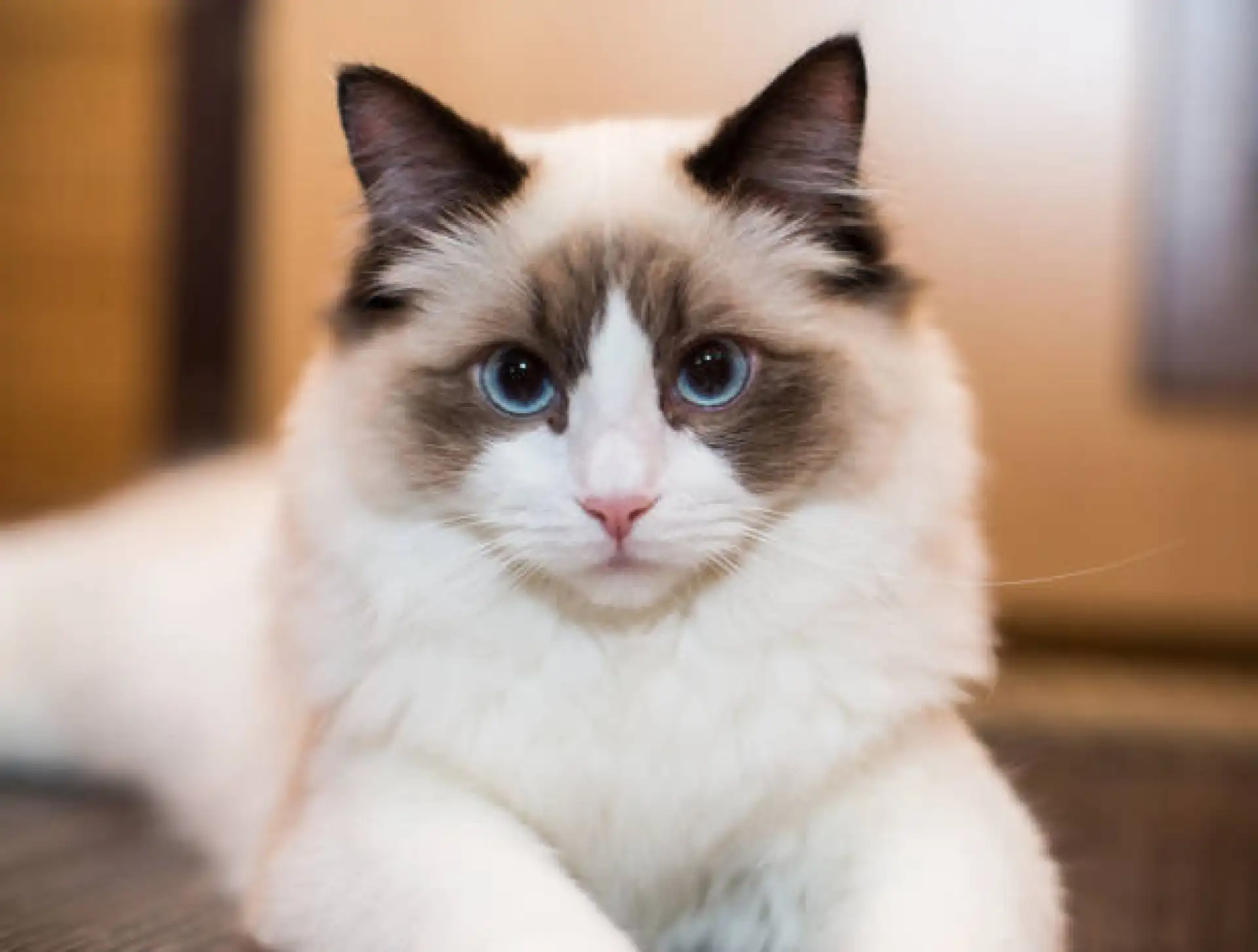 A bicolor Ragdoll — note the white inverted V on the face and the clean white legs, hallmarks of this classic pattern.
Who the Ragdoll Cat Really Is When the Instagram Photos Are Put Away
Here’s the thing about Ragdoll temperament descriptions: they’re all accurate, and they still somehow undersell the reality of living with one.
“Affectionate” doesn’t capture a cat that will follow you to every single room in a house, sit outside the shower, and make low, conversational chirps when you’ve been in another room for too long. “Gentle” doesn’t describe the way a Ragdoll will sit perfectly still while a toddler rearranges its face, then stand up, shake itself off, and go take a nap rather than escalate. “Calm” doesn’t convey a cat that seems to have made a fundamental philosophical decision that nothing is worth getting upset about.
Ragdolls are not lap cats in the demanding, clingy sense — they don’t tend toward the anxious attachment that some Siamese or Devon Rex owners experience. It’s more that a Ragdoll has chosen proximity to humans as its preferred state of being, and it pursues that with quiet, unhurried consistency.
What surprises new owners most:
They’re vocal, but not in an annoying way. Ragdolls have soft, pleasant voices and use them for genuine communication — greeting you at the door, letting you know the food bowl is empty, narrating their thoughts while you’re cooking. Compared to a Siamese, the volume is turned down to something like a polite conversation.
They actually play fetch. Not every Ragdoll, and not reliably, but this is genuinely common enough that it’s considered a breed characteristic. Throw a crinkle ball, watch it disappear under the couch while your cat watches patiently, then retrieve it and drop it at your feet. Repeat.
They don’t always land gracefully. The famous limpness that makes Ragdolls so huggable also means they’re not the most athletic or agile cats. They sometimes miscalculate jumps, startle easily at unexpected sounds, and generally navigate the world with a kind of optimistic confidence that isn’t always matched by physical coordination.
Their trust is both endearing and concerning. Ragdolls approach strangers with zero wariness. They will walk up to your contractor, your neighbor’s child, and the intimidating friend who “doesn’t like cats” with equal openness. This is charming in a safe home and a genuine safety risk outdoors.
They don’t do well alone for long periods. Ragdolls are social enough that they genuinely struggle with isolation. Many owners keep two, or pair a Ragdoll with a dog. A Ragdoll left alone all day every day will show you, eventually, that it’s not okay — through vocalization, clinginess when you return, or occasionally through redecorating your furniture.
Real-World Daily Care for Your Ragdoll Cat (Not the Boring Checklist Version)
Grooming
The Ragdoll coat is one of the breed’s genuine selling points beyond aesthetics — because despite its length and volume, it doesn’t mat the way you’d expect. Without a dense undercoat, the fur doesn’t tangle into the felt-like mats that make owning a Persian a serious commitment. Two to three brushings per week with a stainless steel comb or a slicker brush handles most situations.
Spring and fall bring heavier shedding periods, and during those times, daily brushing is the difference between managing loose fur and finding it in your coffee, your pasta, your professional documents. A de-shedding tool during seasonal blows makes life significantly better.
The belly and the area behind the ears are where tangles do occasionally form — check those spots specifically. And the pantaloon fur on the back legs can pick up litter, which is worth monitoring.
Bathing? Ragdolls tolerate it better than most cats, which is convenient because their white or light-colored coats can show grime. Monthly baths keep the coat looking its best. Start bath routines early in kittenhood and it becomes genuinely unremarkable.
Diet & Weight Management
Large breeds need appropriate calorie management because they’re already large, and Ragdolls have a tendency to eat enthusiastically without naturally self-regulating. A male Ragdoll who free-feeds might hit 25 lbs before you notice the creep happening — which puts serious strain on joints and heart.
High-protein, moderate-fat food with limited fillers is the right direction. Wet food as a significant part of the diet supports hydration and urinary tract health, which matters because Ragdolls have some genetic predispositions (more on those shortly).
Exercise & Enrichment
Ragdolls are not high-energy cats, but “low energy” doesn’t mean “no exercise needed.” Without stimulation, they become sedentary in a way that accelerates weight gain and boredom. Interactive play sessions — wand toys, puzzle feeders, fetch if your cat is inclined — twice daily covers the physical need. Cat trees and window perches handle the environmental enrichment side.
They tend to stay at low to mid-level heights, which is slightly ironic given how much real estate a full-sized Ragdoll occupies. Don’t expect ceiling-high cat trees to get much use.
The Health Realities of Owning a Ragdoll Cat: What You Need to Know Before You Fall in Love
Note: This section discusses health considerations. Please consult your veterinarian for personalized advice.
Ragdolls are generally healthy cats with good lifespans — 12 to 17 years is realistic with proper care. But there are specific health concerns that any prospective owner should understand genuinely, not just skim.
Hypertrophic Cardiomyopathy (HCM) is the big one. It’s the most common heart disease in cats overall, and Ragdolls have a documented genetic predisposition. HCM causes thickening of the heart muscle, which can lead to heart failure, blood clots, or sudden death. There is a genetic mutation (MYBPC3) associated with HCM in Ragdolls, and responsible breeders test for it. But here’s the critical nuance: testing negative for the known mutation doesn’t guarantee a Ragdoll will never develop HCM, because the mutation responsible for the disease may have other, as-yet-unidentified variants.
Annual cardiac ultrasounds are recommended for Ragdolls starting around two years of age. This is not optional if you want to catch problems early enough to manage them.
Polycystic Kidney Disease (PKD) affects some Ragdoll lines, causing cysts to form on the kidneys and gradually impairing kidney function. Reputable breeders screen for this.
Urinary tract issues — particularly bladder stones and FLUTD (Feline Lower Urinary Tract Disease) — appear with some frequency in the breed. Adequate hydration is your primary preventive tool, which is why wet food matters so much.
Dental disease is common across all cat breeds, but Ragdolls’ tendency toward dental overcrowding makes them somewhat more susceptible. Regular brushing (ideally daily, practically a few times a week) and annual professional cleanings are the real-world answer.
Weight management deserves to be listed here as a health concern rather than just a care tip, because obesity in Ragdolls creates a domino effect — joint stress, heart strain, diabetes risk, and reduced mobility that accelerates further weight gain.
When choosing a breeder, ask specifically about HCM and PKD testing, request documentation, and look for breeders who do cardiac screening on their breeding cats with a veterinary cardiologist — not just a regular vet with a stethoscope.
⚠️ Health Disclaimer: This information is for educational purposes only and is not a substitute for professional veterinary advice. Always consult a licensed veterinarian for diagnosis, treatment, and health decisions regarding your cat.
What Does a Ragdoll Cat Actually Cost in the US Today?
The short answer: more than people expect, less than some rumors suggest, and variable enough to warrant explanation.
From reputable breeders, Ragdoll kittens currently range from $1,000 to $3,500 depending on:
- Pet quality vs. show quality — pet-quality kittens (sold with spay/neuter contracts) run $1,000–$2,000; show/breed-quality kittens from championship lines start around $2,500
- Coat pattern and color — mitted and colorpoint are the most common and typically less expensive; rare color combinations like lilac or flame can push prices higher
- Geographic location — breeders in major metro areas often charge more than those in rural areas
- Breeder reputation and health testing investment — breeders doing proper cardiac testing on their lines have higher overhead and price accordingly
Ragdolls from adoption or rescue exist, but they’re genuinely rare. You might find one at a general cat rescue, but specific Ragdoll rescues (Ragdoll Rescue USA is a real resource) occasionally have adults available — often cats surrendered due to life changes rather than behavior problems. Adoption fees typically run $75–$400.
Avoid “budget” Ragdolls priced under $800 from unverified sources. The risk isn’t just getting a poor-quality cat — it’s getting a cat with unscreened HCM lines, an undocumented pedigree, or something that isn’t a purebred Ragdoll at all. The long-term cost of heart disease treatment will make the “savings” look different very quickly.
First-year ownership costs beyond the purchase price — including spay/neuter if not already done, initial vet visits, vaccines, microchipping, quality food, a good cat tree, and supplies — typically run an additional $1,000–$2,000. Budget honestly.
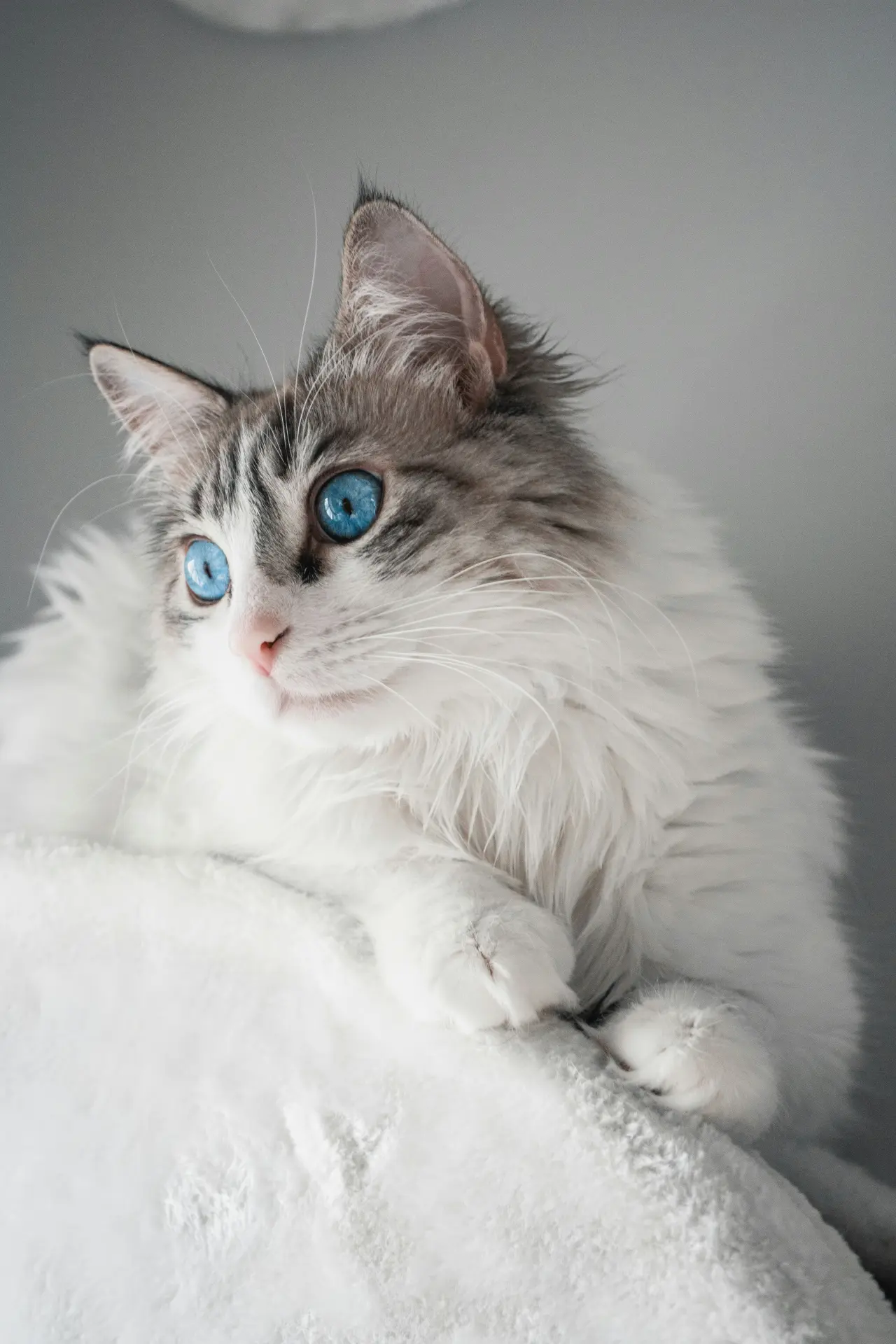 Full-grown Ragdolls are genuinely impressive animals — and a long-term commitment that’s worth planning your budget around carefully.
Frequently Asked Questions About Ragdoll Cats
Do Ragdoll cats really go limp when you pick them up?
Most of them do, yes — and it’s one of those things that’s hard to describe until you experience it. When you lift a relaxed Ragdoll, their body softens and drapes rather than stiffening up the way most cats do. It’s thought to be a combination of selective breeding for extreme docility and a genuine physiological relaxation response, though the science isn’t fully settled. Not every individual Ragdoll does it equally, but if you pick up a well-socialized adult, the “ragdoll effect” is usually noticeable.
Are Ragdoll cats good with kids and dogs?
Genuinely one of the best breeds for multi-species households. Their low aggression threshold means they’re extremely unlikely to scratch or bite a child even when handled imperfectly. With dogs, they tend to adapt well — especially if introduced as kittens — and many Ragdolls will actively seek out a friendly dog as a napping companion. The caveats: very young children need supervision (not because the Ragdoll will hurt the child, but because a child could hurt the cat), and high-prey-drive dogs require careful introductions.
How much do Ragdoll cats shed?
More than many people expect, less than a Persian. Ragdolls have a single coat layer without a dense undercoat, which means they don’t blow coat as dramatically as double-coated breeds. But they’re still large cats with long fur, and that fur ends up on your couch, your sweaters, and occasionally in your coffee. Regular brushing manages it significantly. If you’re highly sensitive to cat hair in your environment, a Ragdoll will still require real adaptation on your part.
Can Ragdoll cats be left alone during the day?
They can tolerate a workday alone reasonably well, but they don’t thrive in extended isolation. Ragdolls are genuinely social animals, and an only cat left alone 10+ hours daily will often show signs of stress or boredom over time. The most common solution is getting two — either two Ragdolls, or a Ragdoll paired with another social cat breed. If that’s not possible, enrichment becomes critical: puzzle feeders, window perches with bird feeders outside, and interactive toys help bridge the gap.
Are Ragdolls hypoallergenic?
No, and this myth needs to stop circulating. Ragdolls produce Fel d 1, the primary cat allergen, at levels similar to other domestic cats. Some people with mild cat allergies find they react less strongly to Ragdolls — possibly because the single-layer coat sheds less dander than some double-coated breeds — but this is not consistent and should never be relied upon. If you have cat allergies and want a Ragdoll, spend time with the specific cat before bringing it home.
How long does it take for a Ragdoll cat to reach full size?
Around four years, which makes Ragdolls one of the slowest-maturing domestic cat breeds. A one-year-old Ragdoll looks like a full-sized cat but may still be 30–40% lighter than their adult weight. Males typically reach 15–20 lbs at maturity; females tend to land between 10 and 15 lbs. This extended kittenhood means you have a surprisingly playful, mischievous young cat for much longer than you might expect from their serene reputation.
What health testing should I ask a Ragdoll breeder about?
At minimum: HCM (Hypertrophic Cardiomyopathy) genetic testing and ideally echocardiograms on breeding cats, and PKD (Polycystic Kidney Disease) genetic testing. Ask for actual documentation — not just verbal assurance. Reputable breeders test breeding pairs and maintain health records, and they’ll share these willingly. A breeder who becomes defensive or vague about health testing is telling you something important.
Do Ragdoll cats do well as indoor-only cats?
They do extremely well as indoor cats — arguably better than most breeds, because their temperament doesn’t include the strong outdoor-roaming drive that makes confinement stressful for some breeds. What they need indoors is space (they’re large, so small apartments can feel cramped), vertical territory, windows with views, and company. The outdoor-only or “free-roaming” lifestyle that some cat owners practice is genuinely dangerous for Ragdolls, whose lack of wariness around strangers and unfamiliar animals makes them vulnerable.
What’s the difference between a Ragdoll and a Ragamuffin?
The Ragamuffin was developed by breeders who broke from Ann Baker’s IRCA program in 1994 and wanted to expand the breed without Baker’s restrictions. Ragamuffins are related to Ragdolls but are not the same breed — they come in a wider variety of colors and patterns (including non-pointed coats), and the breed standard allows for a rounder, slightly different head shape. Both breeds share the large, gentle, people-oriented temperament, but they’re registered separately and have distinct breeding communities.
Is a Ragdoll cat right for first-time cat owners?
In many ways, yes — the Ragdoll’s forgiving, gentle temperament makes them excellent for new cat owners who might not yet know how to read feline body language perfectly. They’re unlikely to scratch or bite in ambiguous social situations, they communicate clearly and calmly, and they tend to adapt to new owners with relative ease. The main consideration for first-timers is the health maintenance component: Ragdolls require consistent vet care, appropriate diet management, and ideally cardiac monitoring that goes beyond a standard annual wellness visit. If you’re prepared to take that seriously, the Ragdoll is one of the most rewarding first cats imaginable.
At the end of the day, the Ragdoll cat is exactly what it appears to be — which is rare in this world. That calmness isn’t a performance. Those blue eyes aren’t calculating something. The cat who follows you to the kitchen at 7 AM isn’t performing affection; it genuinely just wants to be wherever you are.
If you’re the kind of person who wants a cat that meets you more than halfway, who makes houseguests say “I’ve never liked cats before, but —”, who turns your couch into a small, warm universe of fur and contentment: you know what to do.